

How to Choose the Right Basin Mixer Tap: A UK Buying Guide
Tap holes, basin height, spout reach and water pressure decide whether a basin mixer works. Check them in this order, then choose the finish.

Read aloud in your browser. Nothing is sent to us.
A basin mixer is the tap you use most in the bathroom, and the one most often bought on looks alone. The finish matters, but four things decide whether it works: how your basin is drilled, how tall the basin sits, how far the spout reaches, and how much water pressure your home has. Get those right and almost any style you like will do the job well.
This guide walks through each one in the order you should check them, with real examples from our basin mixer taps range.
The short answer
- Match the tap holes first. One hole needs a monobloc mixer; two holes need a pair of pillar taps or a two-hole mixer.
- Match the height to the basin. A standard mixer (around 170mm tall) suits a basin with a tap ledge. A countertop bowl usually needs a tall mixer (roughly 290–340mm).
- Check your water pressure. Many designer mixers need at least 1 bar. A gravity-fed system with a tank in the loft often gives less than that.
- Then choose the finish to suit the rest of the room.
1. Mixer or pillar taps?
A basin mixer (often called a monobloc) brings hot and cold water through one body and one spout, usually with a single lever that sets both flow and temperature. It needs one tap hole and gives a clean, modern look.
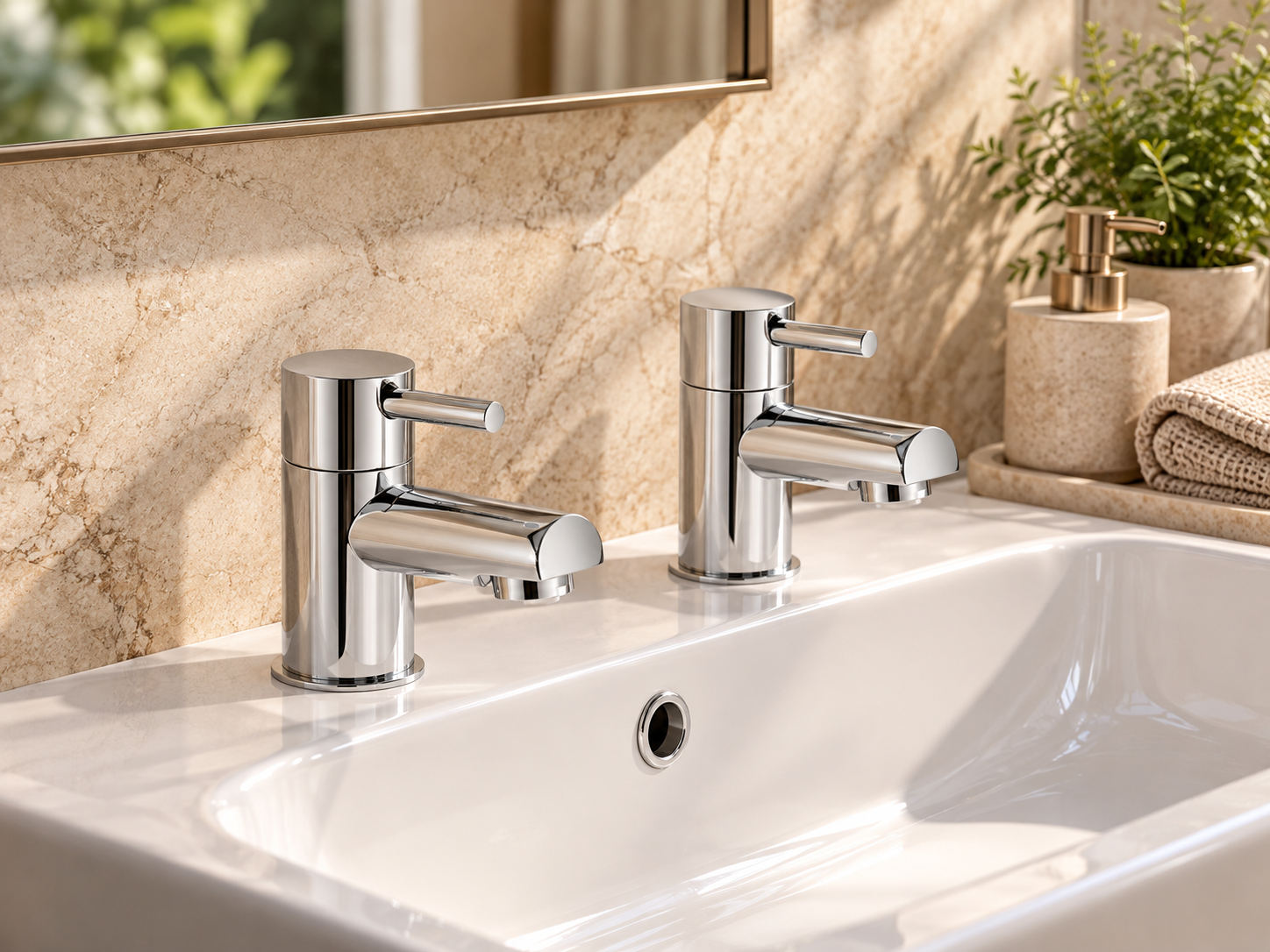
Pillar taps come as a pair: one for hot, one for cold, each in its own hole. They suit traditional bathrooms and basins drilled with two holes, such as the Plan Chrome Pair Basin Pillar Taps. The trade-off is that the water comes out separately, so there is no blended warm stream to wash your hands in.
If you are replacing a tap, count the holes in your basin before anything else. A basin's holes can't sensibly be changed, so the holes decide which family of tap you can fit. You can compare both types across our basin taps.
2. Check how the basin is drilled
Most UK basins are drilled for one tap hole, two, or none at all. A basin with no tap hole is designed for a wall-mounted tap or for a mixer fitted to the worktop beside it. Standard UK tap holes are usually around 35mm across, but confirm the hole size and the thickness of the basin or worktop against the tap's fitting instructions, especially with stone or thick ceramic.
Also look at whether the basin has an overflow (a small slot near the rim). It matters for the waste, which we cover below.
3. Standard height or tall?
This is where most mistakes happen. Height is not a style choice. It follows from the basin.
- Standard basin mixers sit on a basin with a built-in tap ledge, or on a worktop right next to a low basin. Our Artize Confluence Black Chrome Single Lever Basin Mixer is 170mm tall, which is typical.
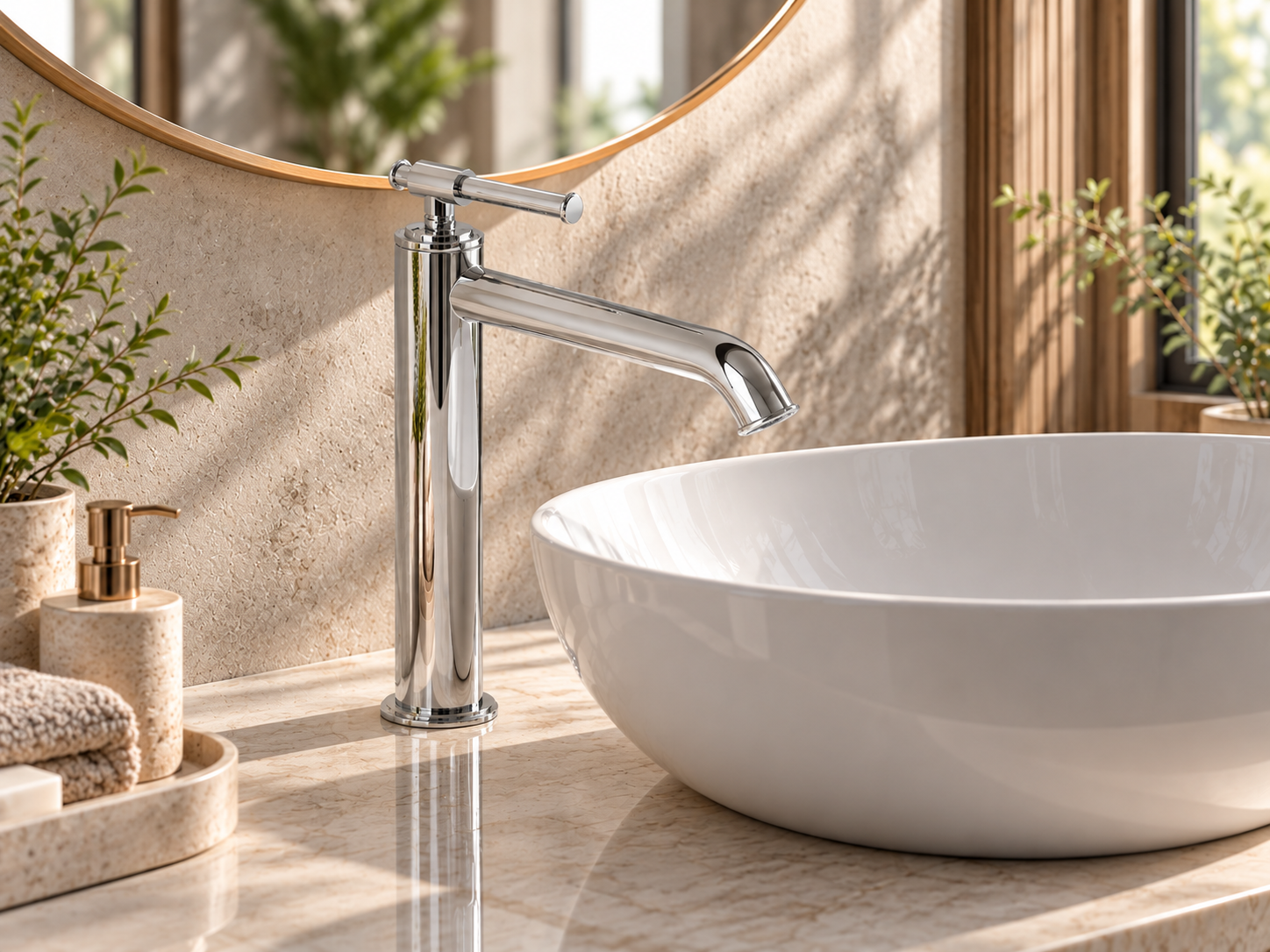
- Tall or "tall-boy" mixers are for countertop or vessel basins, where the bowl sits on top of the worktop. The tap has to rise above the rim and still leave room for your hands. The Artize VIC Chrome Single Lever Tall Boy Basin Mixer is 294mm tall and the Artize Confluence Black Matt Tall Boy is 342mm.
To check, measure from the worktop to the top of the basin rim, then compare it with the tap's height and the height of its spout outlet. The outlet should clear the rim comfortably. Too low and you'll knock your knuckles on the bowl; too high and water splashes out.
| Tap type | Typical height | Fits | Example |
|---|---|---|---|
| Standard basin mixer | about 150–200mm | Basins with a tap ledge | Artize Confluence Black Chrome (170mm) |
| Tall / tall-boy mixer | about 280–350mm | Countertop and vessel basins | Artize VIC (294mm), Artize Confluence Black Matt (342mm) |
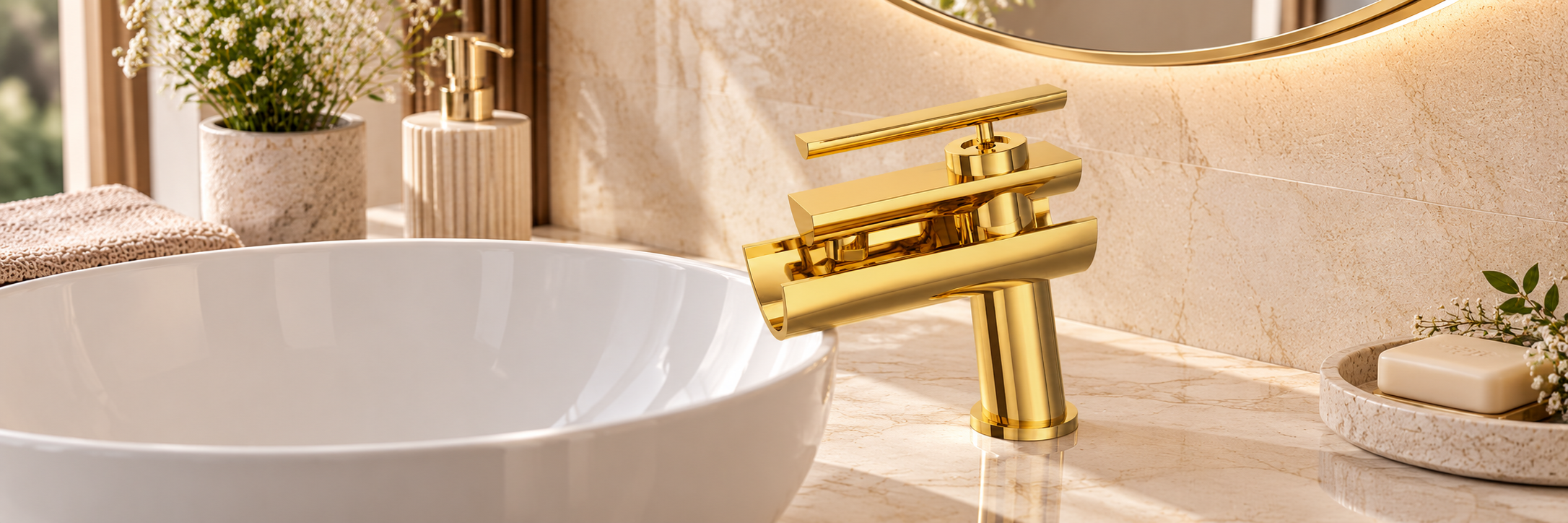
| Extended / high-neck mixer | taller spout, longer reach | Deeper or wider countertop bowls | Jaquar Kubix Prime Gold Matt |
| Pillar taps (pair) | low, separate hot and cold | Basins drilled with two holes | Plan Chrome Pair |
4. Spout reach: where the water lands
Spout reach (sometimes called projection) is how far the spout sticks out from the tap body. Ideally the water lands near the middle of the bowl, close to the waste. A short spout over a deep bowl throws water at the back wall of the basin; a long spout over a shallow basin can splash onto the floor.
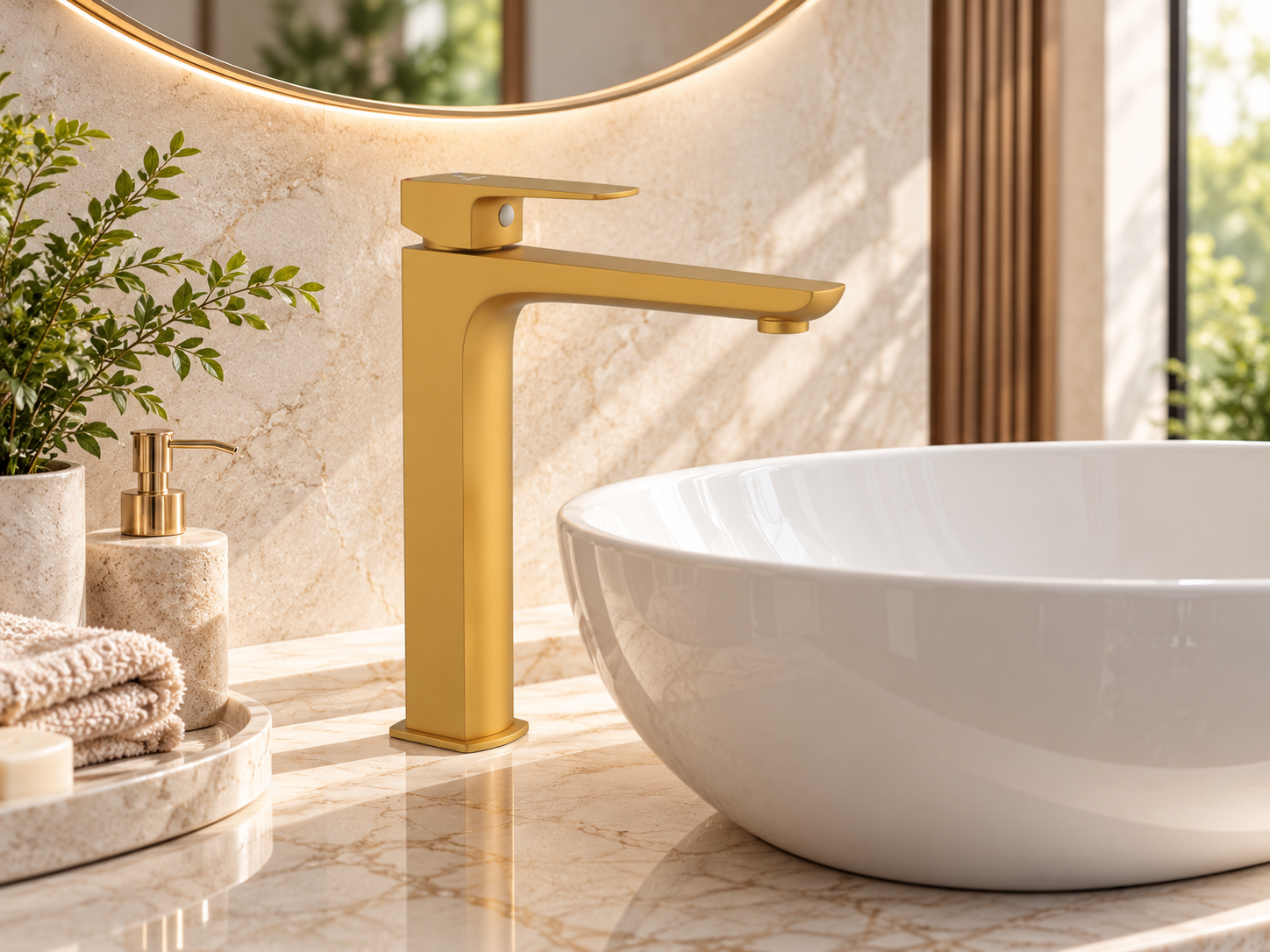
For larger countertop bowls, an extended or high-neck mixer gives both height and reach. Our high neck basin mixers include the Jaquar Kubix Prime Gold Matt PVD Extended Mono Basin Mixer, a square design with a longer spout. Every product page lists the dimensions in its specification, so you can measure your bowl against them.
5. Water pressure: the step most people skip
UK homes have one of two kinds of hot water system, and they behave very differently at the tap.
- Mains-pressure systems (a combi boiler, or an unvented cylinder) usually deliver somewhere around 1–3 bar. Most modern mixers are designed for this.
- Gravity-fed systems (a cold-water tank in the loft feeding a hot water cylinder) are low pressure. A rough rule of thumb is 0.1 bar for every metre the tank sits above the tap, so a tank three metres above your basin gives roughly 0.3 bar.
Each mixer states its operating pressure in the specification. The Artize mixers in this guide are rated for 1–5 bar, and the Jaquar Kubix Prime for 0.5–5 bar. On a low-pressure gravity system, a tap rated from 1 bar may give a weak flow. If you're not sure which system you have, a plumber can measure it in a few minutes. Ask about a pump if you've set your heart on a particular design.
While you're in the specification, look at two more lines:
- Flow rate, in litres per minute. Basin mixers vary widely, from under 6 L/min to over 13 L/min across the taps in this guide. A lower flow uses less water and is plenty for washing hands.
- WRAS approved. WRAS approval shows the tap has been tested against the UK's water fittings regulations, which exist to protect the drinking water supply. All the Artize and Jaquar mixers linked here are WRAS approved.
6. Waste: click-clack, pop-up and overflow
The waste is the plug and fitting in the bottom of the basin. Some mixers come with a pop-up waste worked by a rod behind the tap. Others need a separate click-clack waste, which you press to open and close. Check the product listing to see whether a waste is included.
Then match it to the basin. A basin with an overflow needs a slotted waste, so overflow water can drain away. A basin without an overflow needs an unslotted waste. Fitting the wrong one is one of the most common reasons a new basin leaks or won't drain properly.
7. Choosing a finish
Once the practical boxes are ticked, the finish is yours to enjoy.
- Chrome works with almost everything and is easy to keep bright. The Belva Single Lever Tall Basin Mixer is a simple tall chrome option.
- Matt black gives strong contrast against white basins and pale stone, as with the Artize Confluence Black Matt Tall Boy.
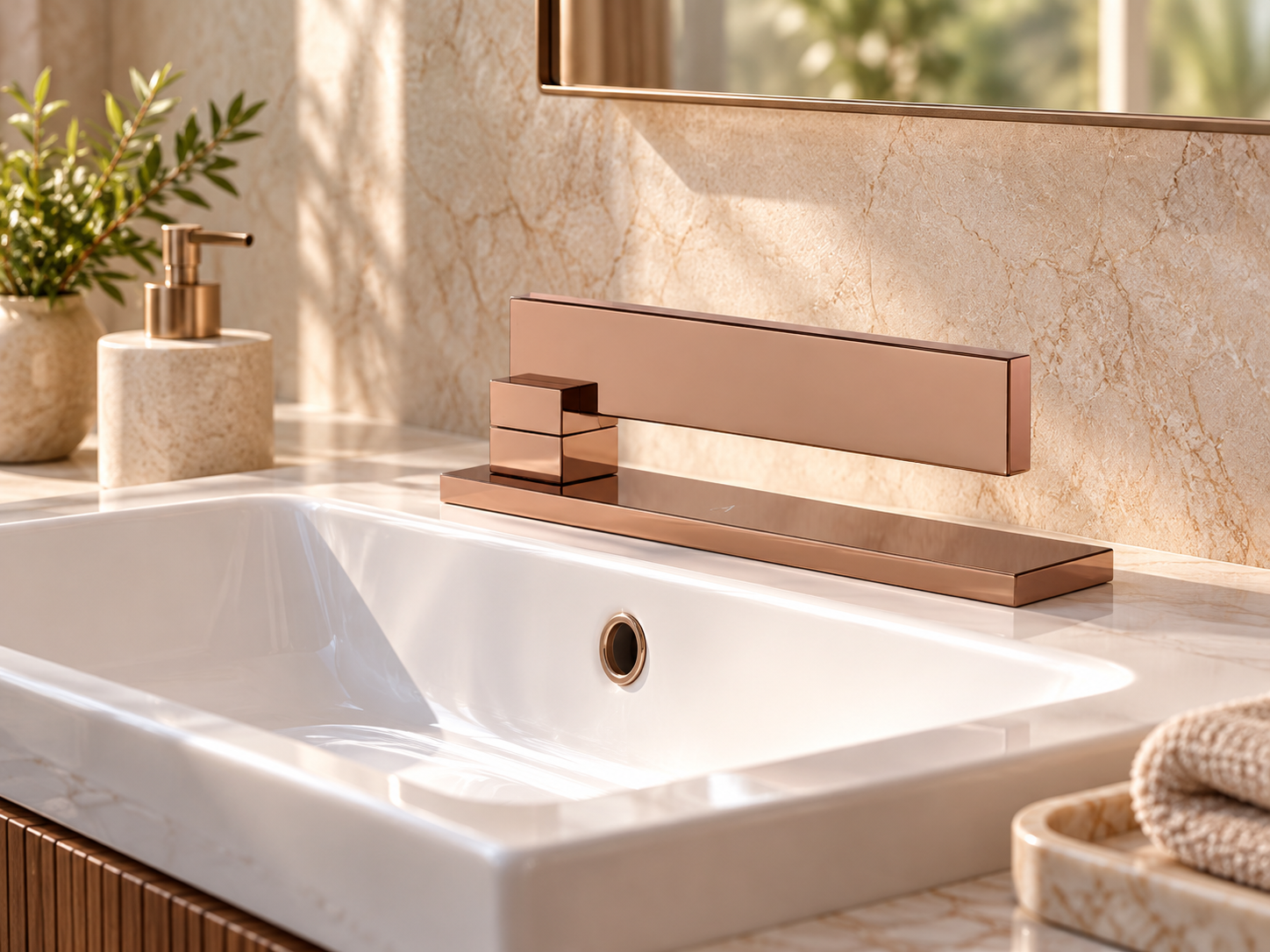
- Gold and blush gold add warmth beside marble, wood and warm neutrals. See the Jaquar Kubix Prime Gold Matt and the Artize Linea Blush Gold PVD Basin Mixer.
- Black chrome sits between the two: darker than chrome, with a soft sheen. Try the Artize Confluence Black Chrome.
PVD (physical vapour deposition) is a coating process used on many coloured finishes, including the gold and blush gold above. Whatever the finish, keep the rest of the room in the same family. Shower controls, the towel rail and the toilet flush plate don't need to match exactly, but two or three finishes that sit well together look planned rather than accidental.
8. Everyday comfort
A single lever is the easiest control for most people, children and older relatives included: one movement for both flow and temperature. Check that the lever sits where a wet hand can reach it easily, and that the spout leaves room underneath to rinse a toothbrush or fill a glass. Most modern mixers use a ceramic disc cartridge, which turns smoothly and resists drips far better than the old washer-type taps.
9. Fitting and looking after it
Fitting a basin mixer is a manageable job for a confident DIYer when the pipework is already in the right place. If the supply pipes need moving, or you're switching from pillar taps to a mixer, use a qualified plumber. Fit isolation valves on the hot and cold supplies so the tap can be serviced later without turning off the whole house.
To keep the finish looking new, wipe it with a soft cloth and mild soapy water, rinse, and dry it to stop limescale marks. Avoid abrasive pads and strong limescale removers on any finish. Coloured and matt finishes are the most easily marked.
Your checklist before you buy
- How many tap holes does the basin have, and what size?
- Is it a basin with a tap ledge (standard mixer) or a countertop bowl (tall mixer)?
- Will the spout reach carry water to the middle of the bowl?
- What water pressure do you have, and what does the tap need?
- Is a waste included, and does the basin need a slotted or unslotted one?
- Is the tap WRAS approved?
- Does the finish suit the other fittings in the room?
Frequently asked questions
What's the difference between a basin mixer and a monobloc tap?
In everyday use, they're the same thing: one tap body that mixes hot and cold water through a single spout. "Monobloc" refers to the single body fitting through one hole.
Can I fit a tall basin mixer on any countertop basin?
Not always. Compare the tap's height and spout reach with the basin's height and depth. The outlet needs to clear the rim and land the water near the centre of the bowl.
Will a basin mixer work with a combi boiler?
Usually, yes. Combi boilers give mains pressure, which is what most modern mixers are designed for. Still check the tap's operating pressure against your system.
Will a basin mixer work on low water pressure?
It depends on the tap. Look for the minimum operating pressure in the specification. Many designer mixers need 1 bar, which a gravity-fed system may not reach without a pump. A plumber can measure your pressure for certain.
Are high-neck and tall-boy mixers the same?
The names overlap and makers use them differently. Both mean a taller mixer for countertop basins. Compare the actual height and spout reach rather than the name.
Does a basin mixer come with a waste?
Some do and some don't. Check the product listing. If you need one separately, choose a slotted waste for a basin with an overflow and an unslotted waste for one without.
Find your basin mixer
Start with your basin and your water pressure, and the right tap narrows down quickly. Browse our basin mixer taps, go taller with our high neck basin mixers, or see all bathroom taps. If you're planning a whole bathroom, our guide to choosing the right bath is a good next read.
In this guide
More from the journal-
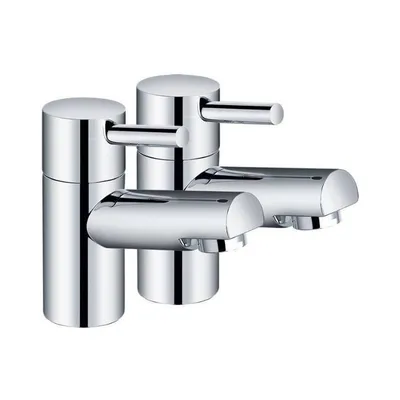 Kartell · TAP015PL Plan Pair Basin Pillar Taps Tap £74.16
-
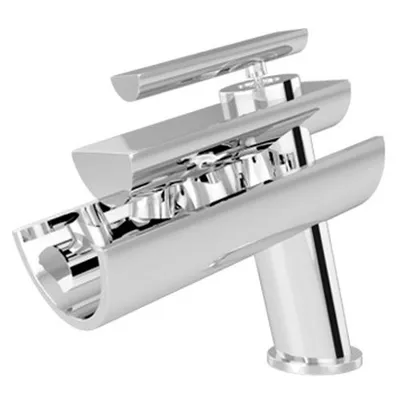 Artize · CNF-CHR-69011B Artize Confluence Single Lever Basin Mixer
Was £593.00Now £533.70 -
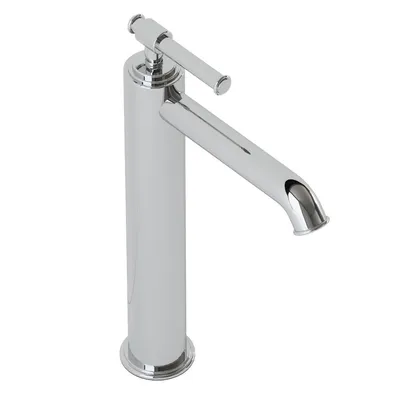 Artize · VIC-CHR-503009B Artize VIC Single Lever Tall Boy Basin Mixer
Was £423.80Now £330.57 -
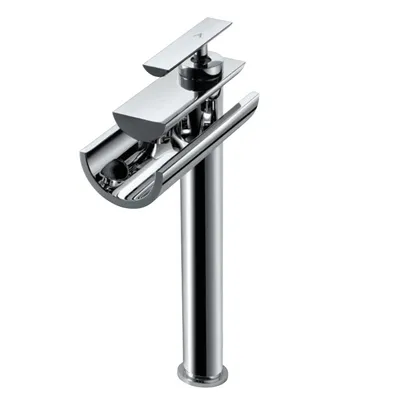 Artize · CNF-CHR-69009B Artize Confluence Single Lever Tall Boy Basin Mixer
Was £666.20Now £532.96
Written by
Sophie Carter
Questions about anything in this guide go to the same people who wrote it, and they answer them.
Ask a question